Oh Luminous Bones!
Heeding the Wisdom of the Blade.

(I’d suggest getting up to speed before carrying on, but do as you will:
Part I
Part II)
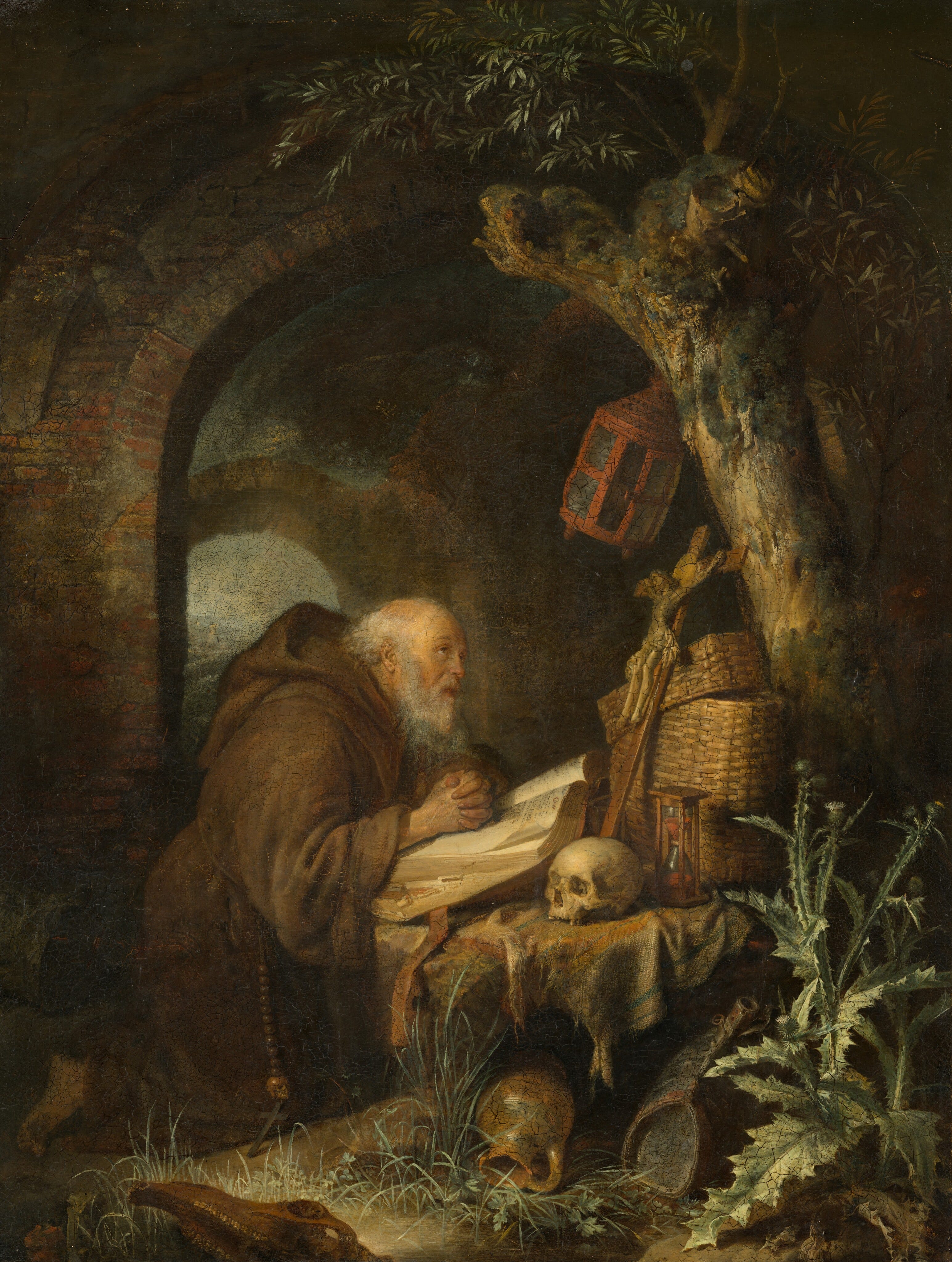
The year is 813 AD.
A strange and solitary man by the name of Pelagius is dwelling, as he has been for some time, in the Libredón forest of what is now Northwest Spain.
In the evening, he sees lights. They seem to dance and flash with a silent agency.
The next night, he sees them again.
And again.
After this third encounter with the humbly luminous, Pelagius seeks the council of his local authority on signs and wonders — Bishop Theodemir.
Together with his clergy, the two allow the allure of this strange radiance to guide them into the hidden places of the forest.
Through branches and brambles, the foreign illuminators tickle them with anticipation and conjure the awe from their spines.
Deeper, stranger, older…
Thud.
The lights vanish.
So unceremoniously.
So unfairly.
Some of the clergy manage to get a torch burning.
The moss here seems to cloak unnatural shapes, or at the very least, un-wild ones.
Corners, angles, straight lines.
It’s a tomb.
And these aren’t just bones, they are relics.
They’re the remains of Saint James — the disciple whom Yeshua had called a “Son of Thunder”.
He’d been beheaded in Jerusalem in 44 AD.
First among the Apostles to be martyred for testifying to the miraculous.
He would not be the last.
844 AD
King Ramiro I of Asturas has inherited a slumped shadow of his forefathers’ kingdom.
Occupying Muslim forces are demanding a steady drip of tribute to maintain the illusion of peace.
On this occasion, their demands have moved beyond the bold and into the vile.
They are requesting that a virgin maiden be delivered to them.
At this, Ramiro at last makes contact with the innermost chamber of his inheritance; for one breath, he inhales the air that is reserved only for true Kings.
He refuses.
There is no utilitarian calculation motivating his decision.
His knees buckle as he vomits into the corner of a limestone flower bed.
He knows what this means. Untold death and torture — likely his own.
The sacking of humble farming villages, displacement of children — how many more young virgins will be raped now that he has refused to diplomatically exchange this one?
It’s senseless.
He knows that his council of advisors will fight and flounder — they will fear for the safety of themselves and their families.
They will beg him to maintain the counterfeit peace.
Not because they are bad men, but because they are good men.
This moment, eternal as the stone, asks Ramiro:
“Will you be a King, or does the line end here?”
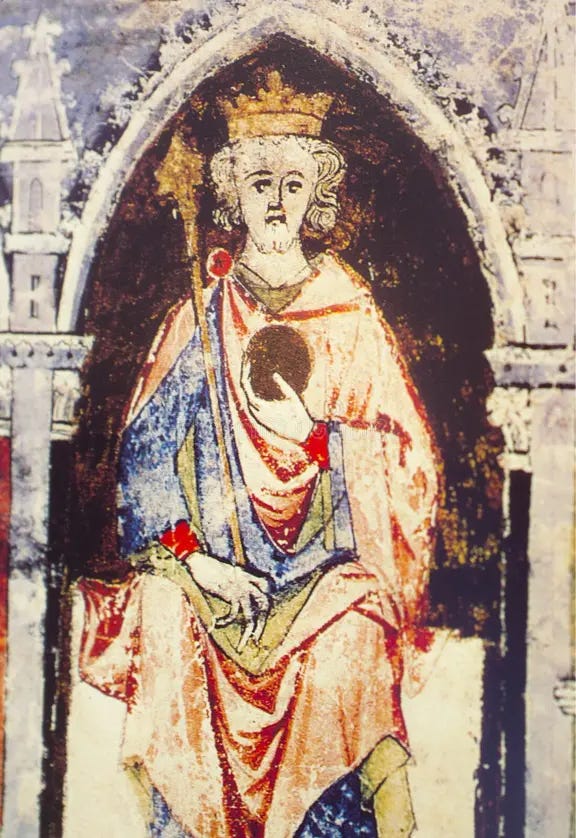
A few months pass.
Ramiro and his crippled forces are completely surrounded and overpowered by the invading Moors.
There is not a clean tunic among them, no man with flesh unbruised.
Ramiro has lost the scent of kings, he smells only blood, only death.
That night as he kneels to pray, he weeps.
He has been so thoroughly emptied already that no tears fall.
Before he can conclude his agonized prayer with any of the formalities, sleep takes him.
And then Dream.
Flickering like moonlight through the tree line.
A Promise.
He awakens feeling soft. Embraced.
He wades through his faithful ranks as the sun takes residence.
There is a new Grace to him.
“Take courage,” he speaks with gentle certainty
“Santiago is with us.”
They won the battle.
As the story goes, the chant of “Santiago!” rose like blooming wildflowers through the ranks of King Ramiro’s soldiers until it reached a holy crescendo.
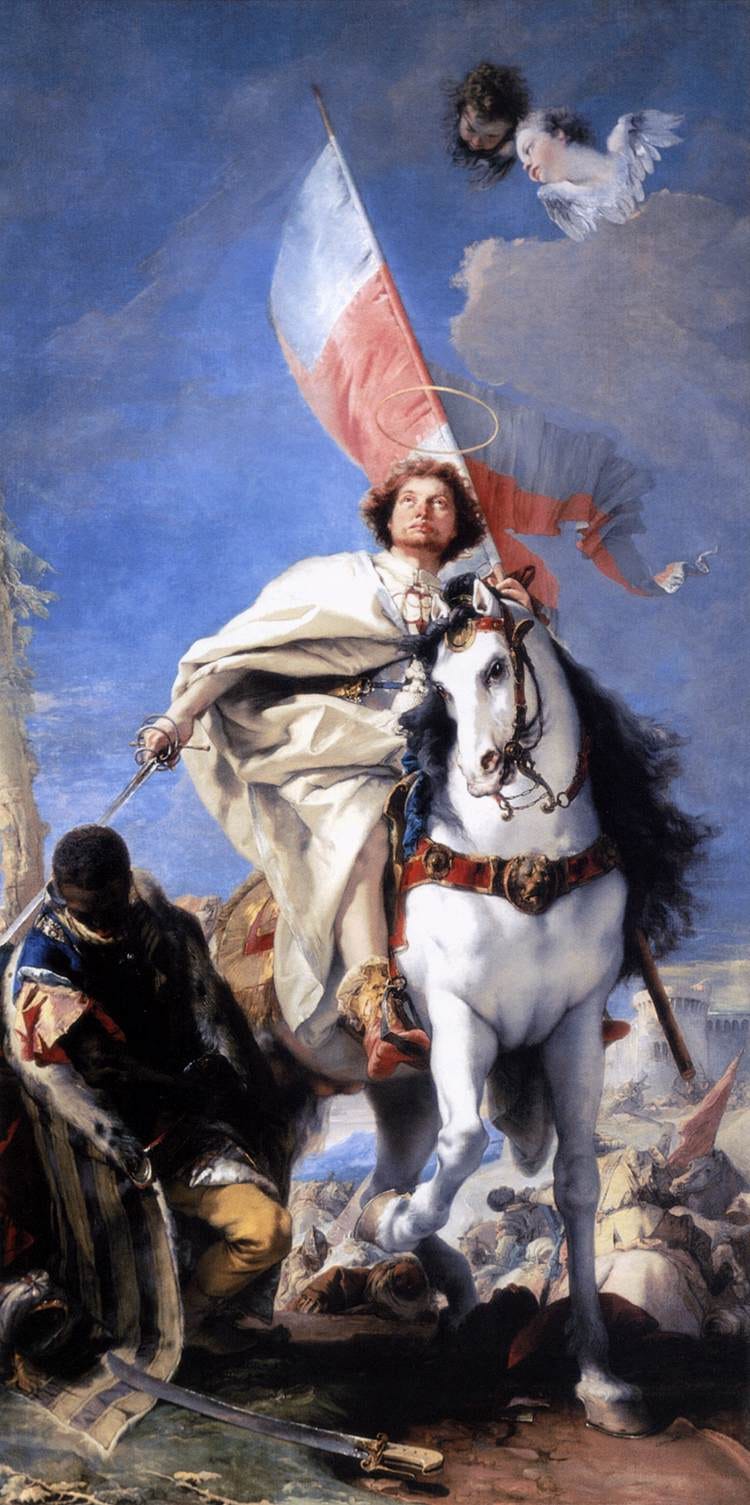
At that precise moment, a rider in white cracked like lightning into the field and ruptured the invading force.
Saint James himself had descended from Heaven with a sword forged in the Ancient Light.
He led the charge on a great white stallion, slaying the Moors by the thousands.
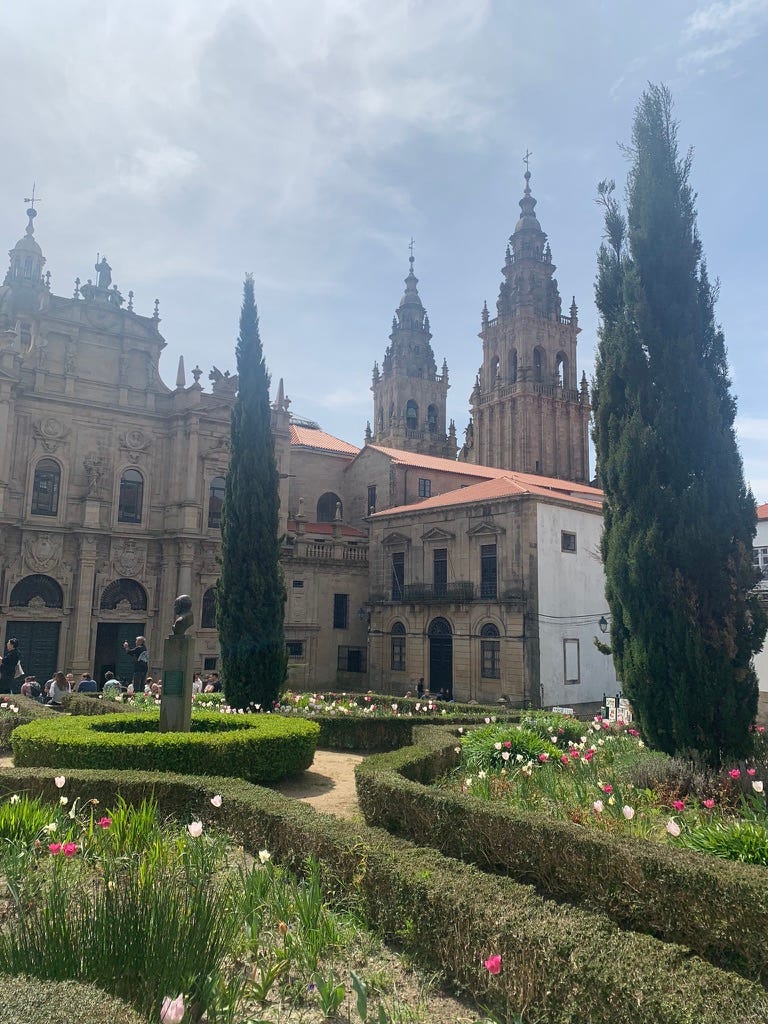
After four and a half weeks on foot, I arrived at the reliquary crypt that housed the bones of Saint James.
I was barefoot and three days fasted — with lips purple from dehydration.
As I rounded the corner to the cathedral courtyard, I heard the sound of bagpipes.
I’d lived a hundred lives in those thirty days.
I’d crossed mountains, rivers, fields, agonies, uncertainties, physical pains, traumas, friendships, romance — threshold after threshold after threshold — and every one of them had been explicitly testing my worthiness to enter the Holy of Holies in which I now stood:
Santiago de Compostela.
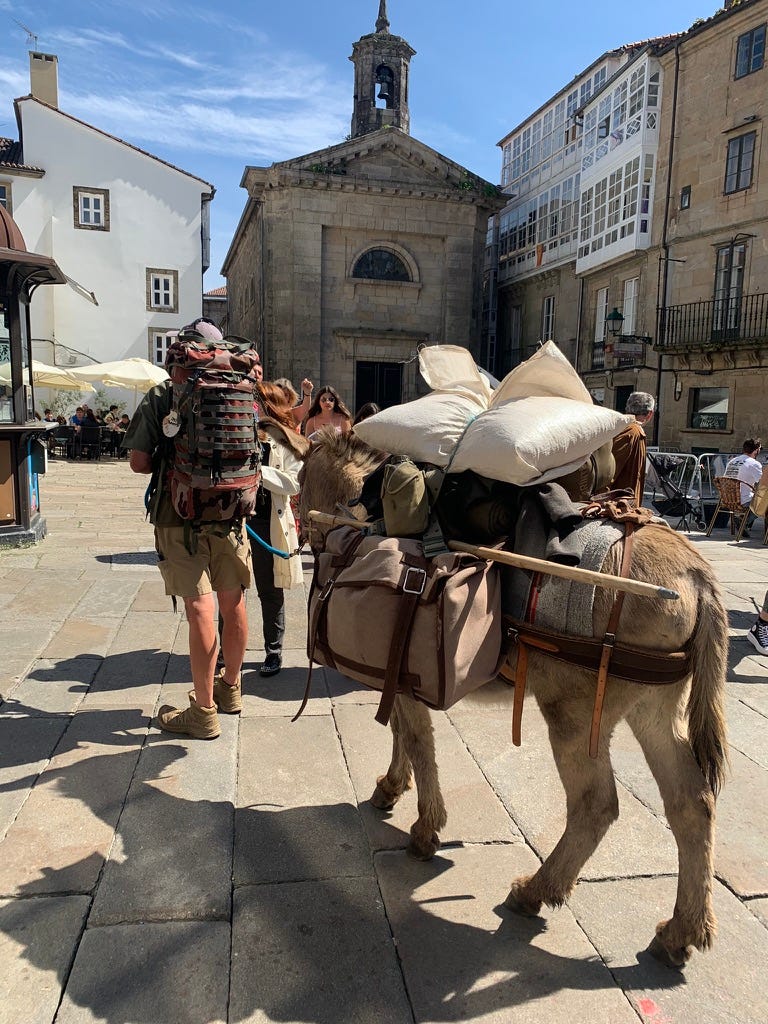
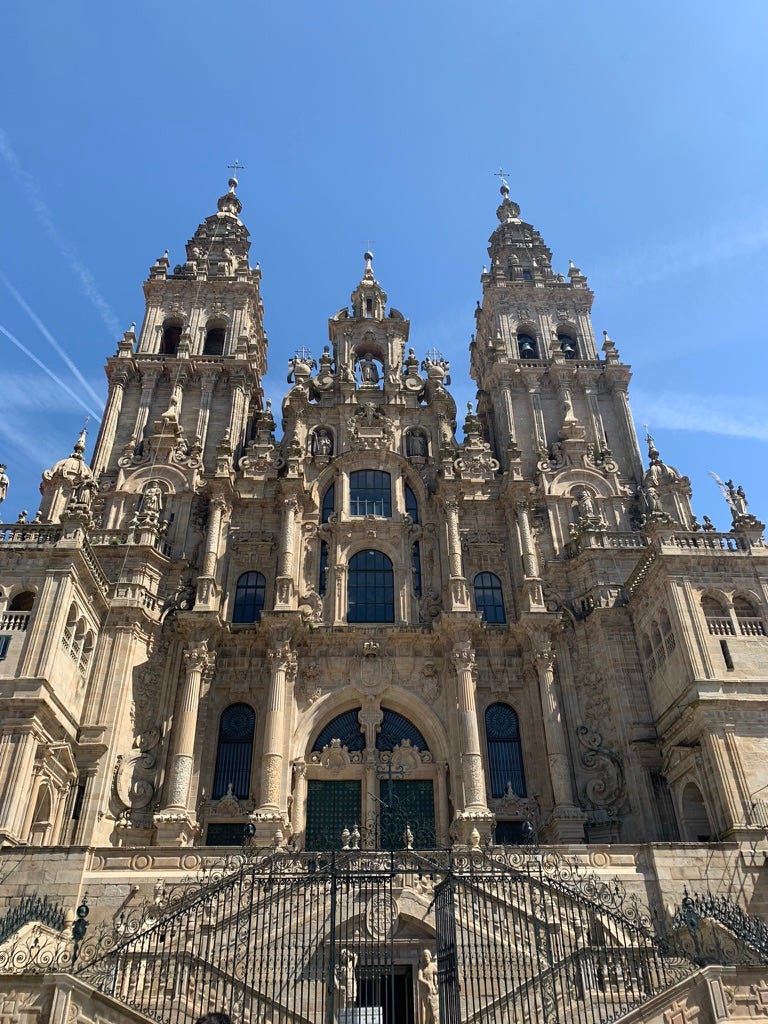
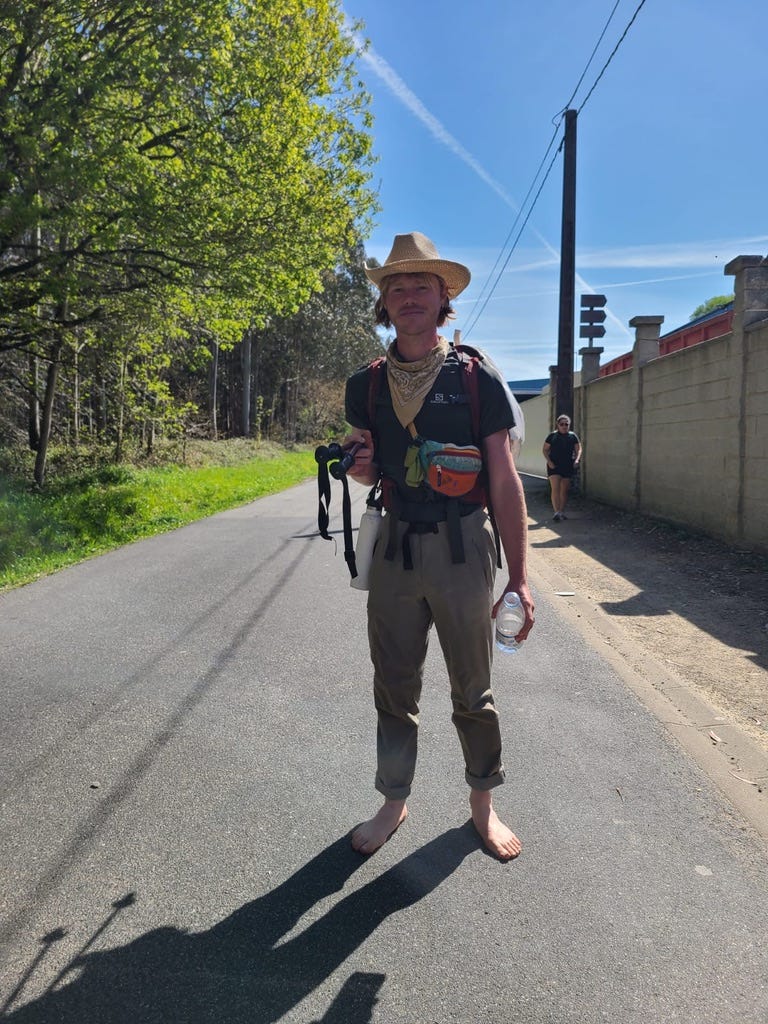
It was Good Friday.
Yes, crucifixion day. I hadn’t planned it, but the final week of my pilgrimage had taken place during Holy Week (the week that precedes Easter Sunday) and the last hundred kilometers were packed shoulder to shoulder with pilgrim-tourists who’d flown in especially for the occasion.
The hostels and inns were overflowing, it was ceremony and procession throughout the city from dawn until dusk.
Past dusk, actually — the vigils were going on all night long.
That final day’s walk had been an agony, start to finish.
For most, it seemed to have an air of ease and celebration to it. The many merry bands of perigrinos that had coalesced in the preceding weeks seemed to skip together with a newfound pep in their step; arrival to the cathedral and her relics a secondary icing atop that rich fulfillment of friendship and quest’s completion.
I walked alone for much of it.
In the chill of morning, many of my own companions had sought to walk with me, but the timid pace that my bare heels and weakened body afforded me ensured that no one was comfortable slowing to my pace for very long.
By the end of the first kilometer (that being the first of about twenty), it was already becoming clear that I’d underestimated the difficulty — the pain — I’d chosen to subject myself to.
My feet had already been on the receiving end of all manner of wear and tear without a moment’s recovery over the last 475 miles of walking. There hadn’t been a single day in the last month that I hadn’t walked at least ten miles.
Even if I had been wearing them, my shoes, which had been good as new four weeks prior now had gaping slits on their sides that would flop open awkwardly as I walked.
Within the first hour or two of that final day, the game I’d need to play with myself in order to survive began to reveal itself:
Find the grass.
Anywhere I could, I’d walk alongside the primarily gravel and asphalt paths leading toward the city to give my soles the softness they cried out for.
It was humbling to say the least, to watch everyone — the elderly, the overweight, the small children — outpace me as I hobbled along at a sloth’s pace, weak and weary. All day long, by the thousands, people came up from behind me and trotted on toward the Holy City.
Once or twice, a Samaritan met me with genuine concern. I was advised to rest, to eat, to put on some damn shoes.
I thanked them.
And refused their help.
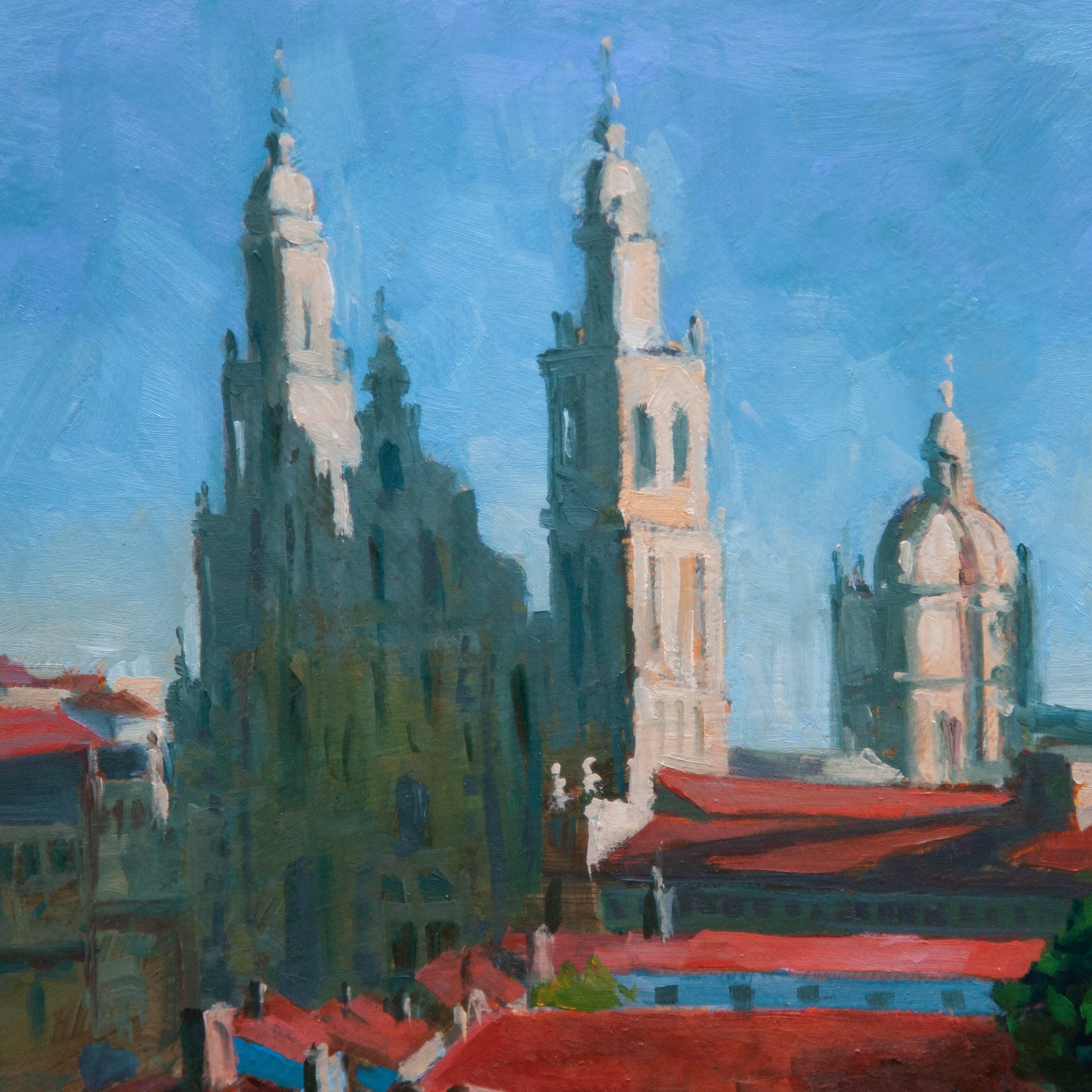
I gazed toward the imposing silhouette of the twin-towered cathedral, faded and blue on the horizon.
What more can I say?
There are some experiences that will forever evade description —
some things are so Real that they could never be pinned to a page.
This kind of transformation, it’s meant to be breathed, not parsed out for palatable consumption.
I expect I’ll be coming back to this well for the rest of my life.
I arrived to heart of the city many hours behind those who had departed with me in the morning.
I was in a state of sustained and stable ecstasy — I felt like those radiant figures I’d seen immortalized in the stained glass.
Me — I — was among them; they weren’t some far off and unattainable ideal — they were inviting me to join them.
I entered the Cathedral. So deliberate was every step. The ancient stone floor cooled and restored my poor blessed feet.
I stepped beneath the earth and into the crypt.
And there I collapsed.
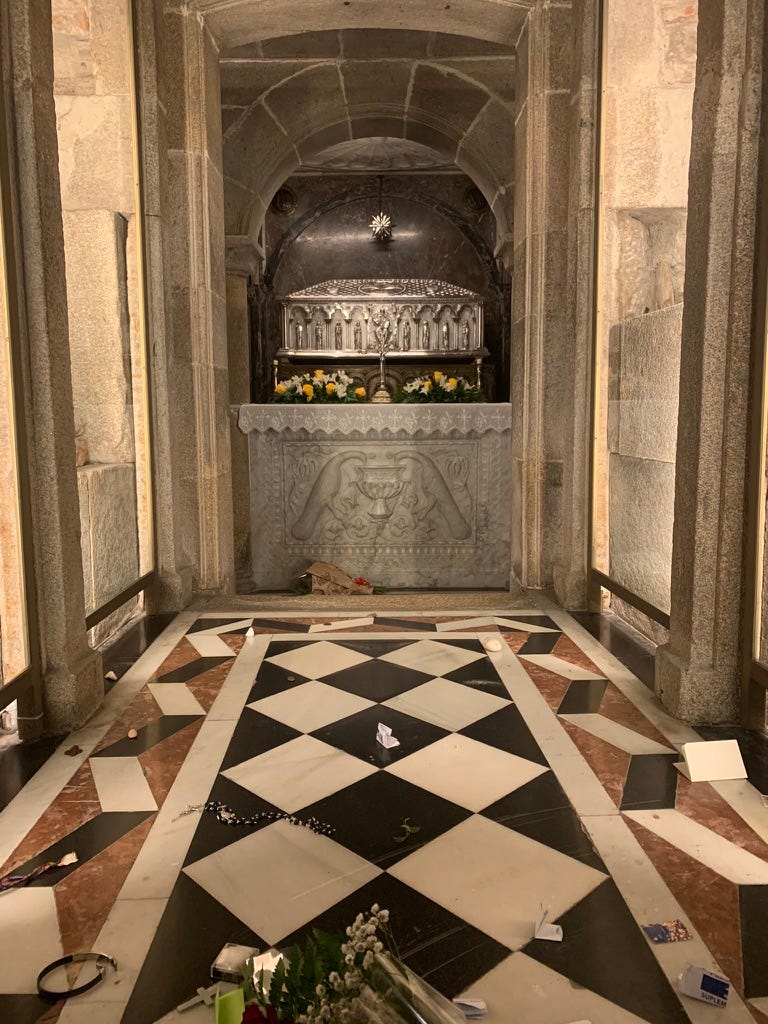
And, about an hour later, I walked out.
With my heart.
Well, we have strayed, haven’t we?
You’ll recall that this trilogy of articles began as a report on my recent fast in the Hawaiian Jungle. And now I am relaying my own dramatized retelling of the history of Saint James’ relics and recounting some of the most important moments of my young life.
I thank you for clinging to the mast with me.
We’re nearly there.
As I sat in the mud of the Hawaiian jungle reading The Pilgrimage till darkness reigned, something that had been gestating for in me for three years at last began to materialize:
My Sword.
Coelho and I had had different motivations as we walked the Camino:
I was seeking my heart, and he, his sword.
But, having most thoroughly recovered my heart on that Good Friday three years ago, I now began to wonder about my own “blade”: the ability to lead — the resources to effect change — to penetrate with certainty and humility.
As I ingested Coelho’s travails recounted in The Pilgrimage, I began to notice that I felt a little afraid.
Whatever he’d gained on his journey, it seemed to have come at such a mighty cost. Such pain, such harrowing. All sorts of things were asked of him that broke his body and his spirit. The same had been true for me. Any glory I’d encountered at journey’s end, the gifts I’d received, they all seemed to have arrived as a result of punishing myself.
Of refusing help.
Even the arrival of my pilgrim-lover — V, in the blue coat — it hadn’t happened until I’d begun bitterly fasting in isolation as a form of flagellation.
And now, as I sought this new gift — my metaphorical sword — I found myself to be in a sort of trauma response.
Reading the book, I feared what I might see next. I feared that it might illuminate some horrid blind spot in my psyche that would ask me again to do something I didn’t want to do.
I haven’t wanted to do any of the things that I’ve done these last years.
On paper, it’s been one swashbuckling adventure onto the next, but privately, I’ve just wanted to be held and told that it’s okay. That I’m okay. That I’m doing a good job.
All my life, I’ve only ever wanted to hear the words:
“Well done, good and faithful servant.” (Matthew 25:23)
I’ve wanted to live in Grace.
Crucifixion, I know so very well.
Show me eternal life.
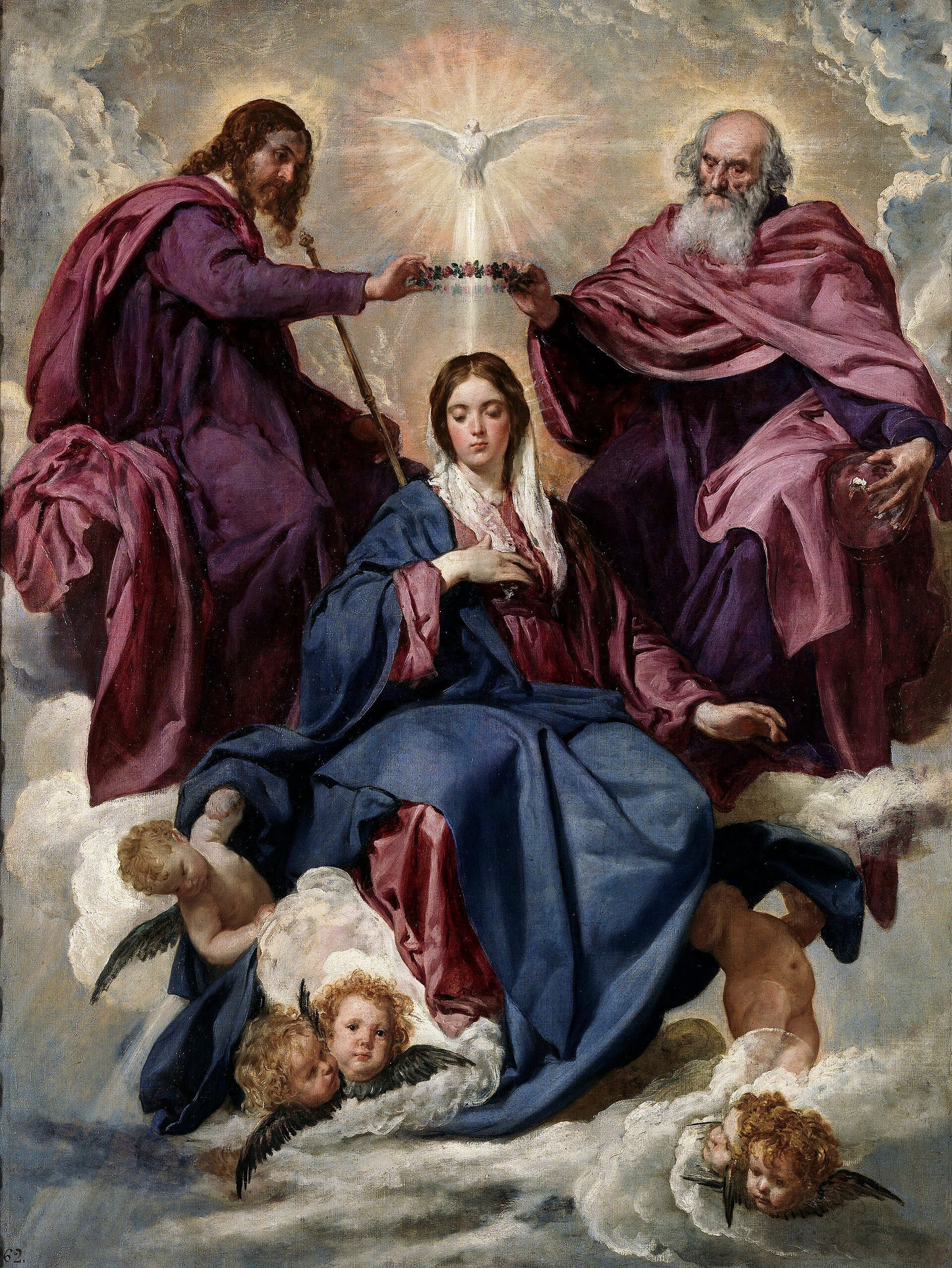
Paolo recovers his sword.
And as I read the passage I began to cry with him.
Toward the very end of his pilgrimage, he finds himself alone at the top of a mountain, looking up to a cross.
An unfettered lamb sits between it and he.
He prays:
“My Lord, I am not nailed to this cross, nor do I see you there. The cross is empty, and that is how it should stay forever; the time of death is already passed and a god is now reborn within me… It is not a sin to be happy.” (220 -221)
It is not a sin to be happy.
I’m whispering it aloud now as I did when I first read it.
Nobody ever told me that. Nobody that I felt I could trust, anyway.
And as this awareness finally began to settle in me, I started to understand why I’d never been granted my sword up to this moment.
I would have used it to spill more blood.
Likely my own blood before anyone else’s — that’s my nature — but it’s the same Old Testament method nonetheless.
I still believed that blood was the cost of our inheritance.
It isn’t.
Our inheritance is ours already.
Paolo’s prayer continues:
“Before finding my sword, I had to discover its secret — and the secret was so simple; it was to know what to do with it.” (220)
My God, how little thought I had given to what I would do with my inheritance once it was reinstated.
I just wanted it,
Because I knew it was mine.
“A god sleeping within me was awakening… I wept with gratitude for Petrus, for his having taught me, without saying a word, that I would realize my dreams if I first discovered what I wanted to do with them. I saw the cross, with no one on it, and the lamb at its base, free to go where he wanted in those mountains and to see the clouds above his head and below his feet” (221).
As I read these words, I began to feel worthy of something which I’d kept spitefully placed on the horizon for the entirety of my adolescent and adult life.
Fulfillment, direction, passion, safety, purpose…
Power.
My sword.
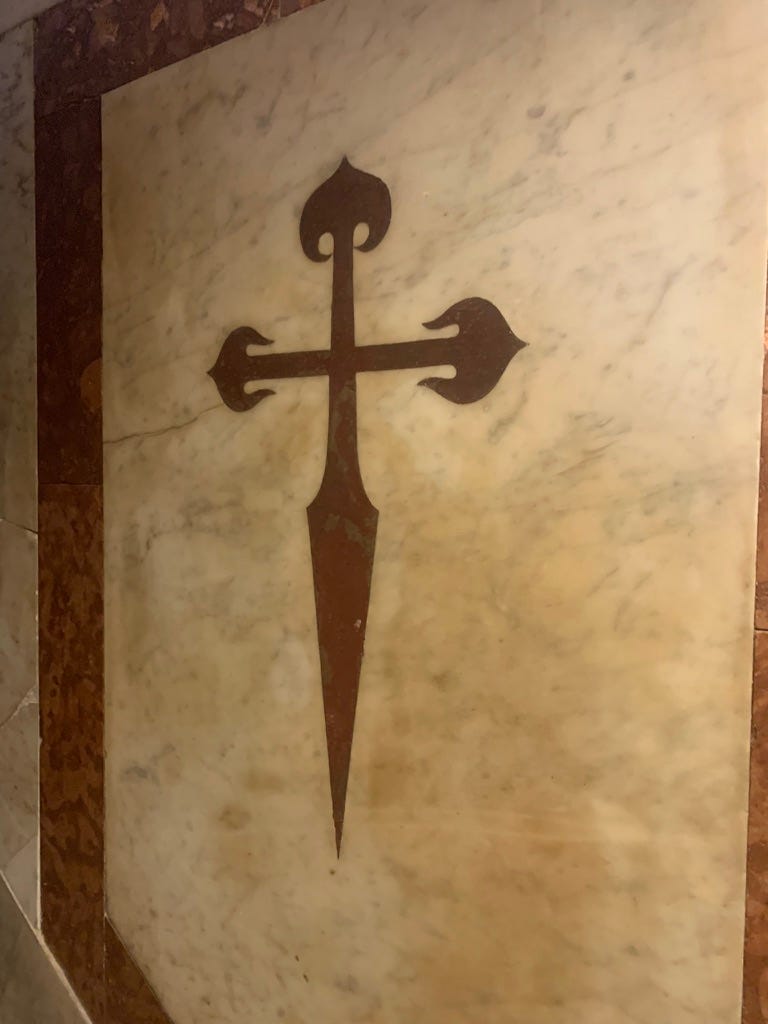
I’ve just spent Easter weekend at my sister’s Anglican church in Texas.
On Thursday night, the priest washed the feet of every man woman and child in that room — just as Christ did for his disciples on the night he was betrayed.
It made me cry, as so many things do these days.
“That’s what it looks like to lead”, I thought.
No, I didn’t think it — I knew it.
Somewhere far deeper than thoughts are allowed to go, I knew it.
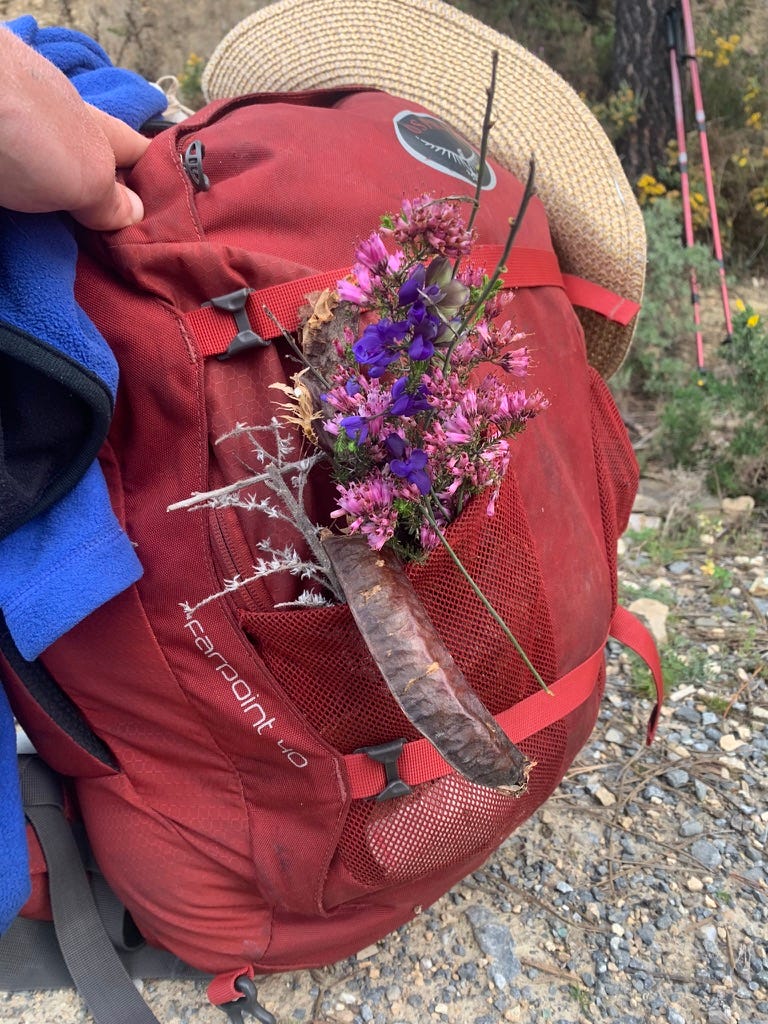
He is Risen,
J
What it feels like: I Was Born For This, by VOCES8
thank you for this series brother. so rich and deeply nourishing.
You are enough!!💞